
A Serbian passport is not a document you can apply for on its own. It is issued only to citizens of the Republic of Serbia. So the real question behind how to get a Serbian passport is a legal one: on what basis can you become a Serbian citizen, and can that basis be proven with the documents you actually hold?
That is where cases are won or lost. The Law on Citizenship of the Republic of Serbia (“Official Gazette of RS”, nos. 135/2004, 90/2007 and 24/2018) opens several routes to citizenship, and they are not interchangeable. Some require years of registered residence in Serbia. Others require none at all. Filing on the wrong basis, or on the right basis with evidence that does not hold up, is the most common reason a file sits unresolved for years and then comes back refused.
All seven routes are set out and compared side by side — conditions, article numbers, timelines and whether residence is required — in our guide on how to get Serbian citizenship. This page starts from the same statute and follows it through to the document itself: what each route means in practice for the passport, and how the passport is applied for, issued and renewed.
This guide sets out how the system works in 2026: what each route really requires, what the passport procedure costs and takes, and where applications fail. It is written by the immigration team at Stojković Attorneys, who file citizenship and passport cases for clients in Europe, the Middle East, North America and Australia. Under Article 39 of the Law, a citizenship request may be submitted through an authorised representative, which is why most of our clients complete the procedure without relocating to Serbia and often without travelling here at all before the decision.
Serbian passport in 2026: the facts that matter
| Question | Answer in 2026 |
|---|---|
| Who can hold one | Citizens of the Republic of Serbia only |
| Routes to citizenship | Descent, emigrant origin, Serbian ethnic origin, marriage, residence, admission in the national interest, reacquisition |
| Residence in Serbia required? | For some routes yes, for several routes no |
| Dual citizenship | Permitted by Serbia. Your own country may not permit it |
| Official fees | Set by the state and by each consulate, and revised during 2026. We confirm the current figures for your case |
| Legal deadline | 30 days in Serbia, 60 days through an embassy or consulate, 48 hours in justified urgent cases |
| Validity | 10 years from age 14, 5 years for ages 3 to 14, 3 years under 3 |
| Travel access | Roughly 135 to 140 destinations visa free or visa on arrival, including the Schengen Area, China, Russia, Turkey and the UAE |
| Decision maker | Ministry of Interior for citizenship, Government of Serbia for admission in the national interest |
The passport follows the citizenship, not the other way round
Article 6 of the Law recognises four grounds on which Serbian citizenship is acquired: by descent, by birth on the territory of Serbia, by admission, and under international treaties. Everything else you may have read about “passport programs” sits somewhere inside those four categories or does not exist at all.
Once citizenship is granted, it still has to become visible in the records before any passport can be printed. Citizenship is proved by an extract from the birth register and by a citizenship certificate, and abroad by a valid Serbian travel document. Applicants who were born outside Serbia and have never lived here are entered into the birth register of a City of Belgrade municipality, and only then into the register of citizens.
This administrative step is invisible in most online guides and it is where a surprising number of self-filed cases stall. People receive the decision granting citizenship, assume the matter is finished, and then discover months later at a consulate that nothing was ever registered, so no passport can be issued.
The routes to Serbian citizenship, and who each one is really for
Below is the comparison that matters before anything is filed. The differences in the last two columns are what decide whether a case takes months or years.
| Route | Legal basis | Residence in Serbia | Must you renounce your current citizenship? |
|---|---|---|---|
| Descent from a Serbian parent | Articles 7, 9 and 10 | Not required | No |
| Emigrant and descendants of an emigrant | Article 18 | Not required | No |
| Member of the Serbian nation | Article 23 | Not required | No |
| Marriage to a Serbian citizen | Article 17 | Permanent residence required, plus 3 years of marriage | No |
| Naturalisation through residence | Article 14 | Permanent residence plus 3 years of registered residence | Yes, with statutory exceptions |
| Born on the territory of Serbia | Article 16 | 2 years of continuous stay | No |
| Admission in the interest of Serbia | Article 19 | Not required | No |
| Reacquisition by former citizens | Article 34 | Not required | No |
Descent from a Serbian parent
A child born abroad to one Serbian parent and one foreign parent does not become a citizen automatically. Citizenship by descent depends on registration, and registration has deadlines. The parent must register the child with a Serbian diplomatic or consular mission, or with the competent authority in Serbia, before the child turns 18. Where that never happened, the person can still claim descent themselves, but the request has to be filed before they turn 23.
The age of 23 is a hard line and we see the consequences of missing it every month. After that birthday the descent route closes, and the case has to be rebuilt on a different legal basis, usually Article 18 or Article 23. That is still possible in many families, but it is a different file, with different evidence, and it is worth having the assessment done well before the deadline rather than after.
One point that is frequently misstated online: descent under Articles 7 to 10 runs from a parent, not from a grandparent or a great grandparent. Claims based on a grandparent who left Serbia are real and they succeed, but they succeed under the emigrant provision, not under descent. Our full breakdown of this route is set out on our citizenship by descent page.
Emigrants and their descendants
Article 18 is the provision that quietly serves most of the diaspora. An emigrant, meaning a person who left Serbia intending to live permanently abroad, and any descendant of that person, may be admitted to citizenship on reaching 18, provided they submit a written statement that they consider Serbia their country. There is no residence requirement, no language examination and no obligation to give up an existing nationality. The spouse of a person admitted this way may follow on the same basis.
The generational reach of this route is what makes it valuable, and the evidence is what makes it difficult. The Ministry has to be satisfied that the ancestor was in fact an emigrant from Serbia and that the family line to you is documented. In practice that means birth, marriage and death records from several countries, often in languages and archives that no longer exist in the form they did when your family left, all of it apostilled and translated by a court certified translator. Assembling that chain is the substance of the work, and it is the part clients most often ask us to take over after their own attempts return incomplete.
Members of the Serbian nation
Article 23 gives a person of Serbian ethnic origin who has no residence in Serbia the right to be admitted to citizenship without release from their existing citizenship, provided they are 18, have legal capacity, and submit the statement recognising Serbia as their country. The same provision covers people born in another former SFRY republic who came to Serbia or went abroad as refugees, displaced or expelled persons, and members of other nations or ethnic communities from the territory of Serbia.
The wording is generous, and the evidentiary practice is stricter than the wording suggests. What counts as proof of ethnic origin is decided on the file in front of the officer, which is precisely why identical family situations produce different outcomes depending on how the case was presented.
Marriage to a Serbian citizen
A foreign national who has been in a marital union with a Serbian citizen for at least three years and who has been granted permanent residence in Serbia may be admitted to citizenship on the strength of the written statement alone. There is no requirement to renounce the original citizenship, which makes this one of the cleaner routes for mixed families.
Both conditions have to be satisfied at the moment of filing: three years of a subsisting marriage, and permanent residence already approved. Permanent residence is itself a separate procedure with its own evidence, and it typically follows three years of continuous temporary residence. We cover the practical side of that in our guide to marriage to a Serbian citizen.
Naturalisation through residence
This is the route most people imagine when they think of citizenship, and it is the slowest. Article 14 requires that the applicant has been granted permanent residence, is at least 18 with legal capacity, has been released from their foreign citizenship or can prove that release will follow, has had a registered address in Serbia continuously for at least three years before filing, and submits the statement recognising Serbia as their country.
The timeline that follows from this is longer than most guides admit. Permanent residence generally becomes available after three years of continuous temporary residence, and the three years of registered residence required by Article 14 run after that status exists. In practice that is around six years of genuine, documented life in Serbia before a naturalisation request is even ready to file. Anyone who tells you three years is enough is describing only the second half of the process. Our guide to the Serbian residence permit sets out how that clock actually runs.
The release requirement is softer than it reads. Where a foreign state does not allow release, or sets conditions the applicant cannot meet, a declaration of renunciation effective on acquisition of Serbian citizenship is sufficient, and release is not demanded where it is impossible or cannot reasonably be expected. Whether your country falls into that category is a legal question with a documented answer, not a matter of opinion.
Admission in the interest of Serbia
Article 19 allows a foreign national whose admission would represent an interest for the Republic of Serbia to be granted citizenship without the residence, release and statement conditions of Article 14. The Government decides, on the proposal of the competent ministry, and the spouse of a person admitted this way may follow.
This is a discretionary route and it is the one most misrepresented by intermediaries. There is no fee schedule, no investment threshold and no entitlement. What exists is a legal test of interest to Serbia, and the outcome depends on how a profile is documented, positioned and proposed. We assess these cases before anything is filed and we say clearly when the answer is no. The framework and the profiles that realistically qualify are set out on our citizenship by exception page.
Reacquisition by former citizens
A person who was released from Serbian citizenship, or whose citizenship ended at a parent's request while they were a minor, may reacquire it on reaching 18 by filing a request and submitting the statement recognising Serbia as their country. This is common among people who gave up Serbian nationality decades ago because their new country did not allow dual citizenship at the time, and it is usually one of the more straightforward files we handle.
Dual citizenship: what Serbia allows and what your own state allows
Serbia permits dual citizenship, and a Serbian citizen who also holds a foreign nationality is treated as a Serbian citizen while on Serbian territory. On the routes based on origin, marriage, exception or reacquisition, nothing is asked of your existing passport at all.
The risk sits on the other side. Several states withdraw their nationality automatically when a citizen voluntarily acquires another, and some tie tax or military obligations to the change. That analysis belongs at the start of the case, not after a decision has been delivered, because acquisition takes effect on the day the decision is served and cannot be quietly undone.
How the decision is made, and why a complete file can still be refused
Requests are decided by the Ministry of Interior. By law the procedure is treated as urgent, and it is filed with the police department for the applicant's place of residence or through a Serbian diplomatic or consular mission, either in person or through an authorised representative.
Two provisions deserve attention because they explain outcomes that otherwise look arbitrary. First, if the applicant fails to take a required step after a warning, the procedure can be discontinued after three months, or six months where the applicant is abroad. Files that go quiet on the applicant's side do not wait indefinitely. Second, the Ministry may refuse a request even where every statutory condition is met, if it assesses that reasons of interest for the Republic of Serbia justify refusal. Meeting the conditions creates a strong position, not a guarantee, and how the file reads matters.
Citizenship is acquired on the day the decision is served. Where the only condition was the statement recognising Serbia, it is acquired on the day that statement is given.
The passport procedure once you are a citizen
Compared with the citizenship stage, this part is administrative. Biometric passports are issued by the Ministry of Interior in Serbia and through diplomatic and consular missions abroad, and biometric data has to be captured in person, so this is the point in the process where attendance is unavoidable.
Inside Serbia the legal deadline for issuing a passport is 30 days from submission, and in practice it is often considerably faster. Through an embassy or consulate the deadline is 60 days, because the booklet is produced in Serbia and returned through diplomatic channels. In justified urgent cases, such as medical treatment abroad, the death or serious illness of a close relative, or urgent business travel, a passport can be issued within 48 hours.
Official fees are payable at this stage, and they changed during 2026. They are set by the state for applications made in Serbia and separately by each mission abroad, which is why quoted figures found online are frequently out of date or simply wrong for the country you are in. We confirm the current amounts for your specific case, together with everything else the file will cost, before anything is filed.
Validity is ten years from the age of 14, five years for children between three and 14, and three years for children under three. For a minor, one parent files with the written consent of the other, and there are documented exceptions where that consent cannot be obtained. Serbia moved to a redesigned burgundy booklet during 2026, and passports issued earlier stay valid until the date printed inside them. We deal with the practical questions around replacement in our guide to Serbian passport renewal in 2026.
What a Serbian passport is
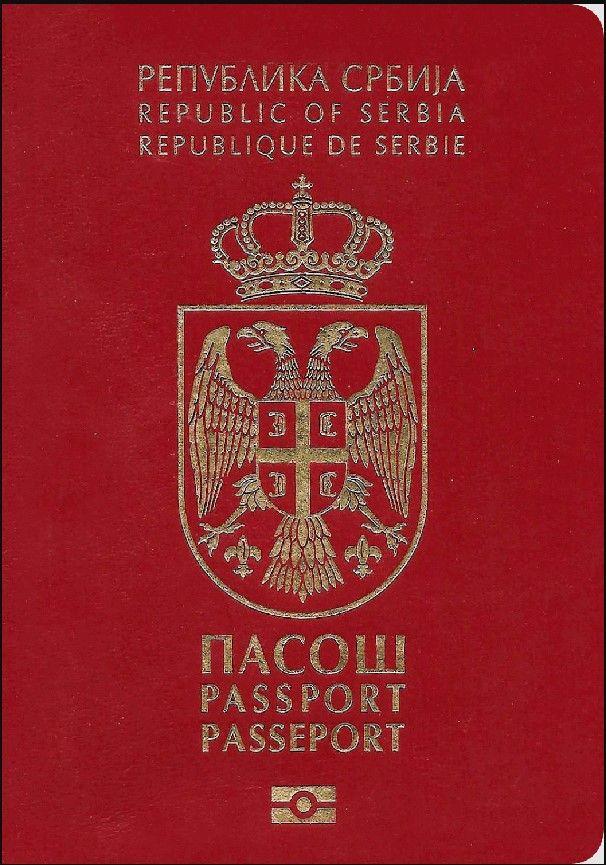
Serbia has issued biometric passports since July 2008. The booklet holds a chip with the holder's facial image and fingerprints, it is produced centrally in Serbia, and it is issued by the Ministry of Interior at home and by Serbian diplomatic and consular missions abroad. During 2026 the document was redesigned: the cover moved from the older maroon to burgundy, the internal graphics changed and further security features were added. Passports issued before the redesign stay valid until the date printed inside them, so a change of design is not a reason to replace a passport that still has time on it.
A few characteristics matter in practice. Validity runs ten years from the age of 14, five years between three and 14, and three years below that. A biometric passport cannot be extended, so a replacement is always a new issuance rather than a renewal in the literal sense. A citizen may not hold two valid Serbian passports at the same time, which is why the previous booklet is cancelled when the new one is collected.
Where a Serbian passport takes you
Serbian nationals reach roughly 135 to 140 destinations without a visa or with a visa on arrival, which places the passport somewhere around 30th to 33rd worldwide depending on which index is doing the counting. The number that matters more than the ranking is the combination: Serbia is one of a very small group of countries whose citizens travel visa free to the Schengen Area, China and Russia alike. Turkey, the UAE, Japan, Singapore, Brazil and most of Latin America are open as well.
| Requirement | Destinations | Where |
|---|---|---|
| Visa free | 101 | Albania, Andorra, Antigua and Barbuda, Argentina, Armenia, Aruba, Austria, Azerbaijan, Barbados, Belarus, Belgium, Bonaire, St. Eustatius and Saba, Bosnia and Herzegovina, Brazil, Bulgaria, Chile, China, Colombia, Cook Islands, Costa Rica, Croatia, Cuba, Curacao, Cyprus, Czech Republic, Denmark, Dominica, Dominican Republic, Ecuador, Estonia, Eswatini, Faroe Islands, Fiji, Finland, France, French Guiana, French Polynesia, French West Indies, Gambia, Georgia, Germany, Greece, Greenland, Grenada, Haiti, Hong Kong, Hungary, Iceland, Iran, Israel, Italy, Japan, Kazakhstan, Kosovo, Kyrgyzstan, Latvia, Liechtenstein, Lithuania, Luxembourg, Macao, Malta, Mayotte, Micronesia, Moldova, Monaco, Mongolia, Montenegro, Netherlands, New Caledonia, North Macedonia, Norway, Palestinian Territories, Panama, Peru, Poland, Portugal, Reunion, Romania, Russia, San Marino, Singapore, Slovakia, Slovenia, Spain, St. Maarten, St. Pierre and Miquelon, St. Vincent and the Grenadines, Suriname, Sweden, Switzerland, Tajikistan, Trinidad and Tobago, Turkey, Ukraine, United Arab Emirates, Uruguay, Uzbekistan, Vanuatu, Vatican City, Wallis and Futuna, Zambia |
| Visa on arrival | 35 | Bangladesh, Bolivia, Burundi, Cambodia, Cape Verde, Comoros, Djibouti, Egypt, Guinea-Bissau, Indonesia, Jamaica, Jordan, Kuwait, Laos, Lebanon, Madagascar, Maldives, Mauritania, Mauritius, Mozambique, Nepal, Nicaragua, Niue, Oman, Palau, Qatar, Rwanda, Samoa, Seychelles, Sri Lanka, Tanzania, Thailand, Timor-Leste, Tuvalu, Zimbabwe |
| Electronic travel authorisation | 2 | Kenya, South Korea |
| eVisa before travel | 32 | Australia, Bahamas, Bahrain, Benin, Bhutan, Botswana, Burkina Faso, Cameroon, Congo (Dem. Rep.), Côte d’Ivoire, Equatorial Guinea, Ethiopia, Gabon, Guinea, India, Lesotho, Libya, Malawi, Malaysia, Montserrat, Myanmar, Nigeria, Pakistan, Saint Kitts and Nevis, Sao Tome and Principe, Sierra Leone, South Sudan, St. Helena, Syria, Togo, Uganda, Vietnam |
| Visa required | 59 | Afghanistan, Algeria, American Samoa, Angola, Anguilla, Belize, Bermuda, British Virgin Islands, Brunei, Canada, Cayman Islands, Central African Republic, Chad, Congo, El Salvador, Eritrea, Falkland Islands, Ghana, Gibraltar, Guam, Guatemala, Guyana, Honduras, Iraq, Ireland, Kiribati, Liberia, Mali, Marshall Islands, Mexico, Morocco, Namibia, Nauru, New Zealand, Niger, Norfolk Island, North Korea, Northern Mariana Islands, Papua New Guinea, Paraguay, Philippines, Puerto Rico, Saint Lucia, Saudi Arabia, Senegal, Solomon Islands, Somalia, South Africa, Sudan, Taiwan, Tonga, Tunisia, Turkmenistan, Turks and Caicos Islands, United Kingdom, United States of America, US Virgin Islands, Venezuela, Yemen |
The United States, United Kingdom, Canada and Ireland require a visa, and Australia and India are reachable on an electronic visa applied for in advance. Requirements move in both directions from year to year, so the list above is a planning aid rather than a substitute for checking the destination's own rules before booking.
What the passport does not give you
Two clarifications we give clients regularly. A Serbian passport is not an EU passport. Serbia is a candidate country in accession negotiations, and holders travel to the Schengen Area under the visa free regime, limited to 90 days in any 180, without the right to live or work there. Separately, the EU Entry/Exit System became fully operational in April 2026 and crossings are now recorded biometrically, so the 90 in 180 rule is enforced automatically rather than by counting stamps. ETIAS, the pre travel authorisation that will eventually apply to visa free travellers including Serbian nationals, is still not in operation and its launch date is under review, so nothing is required for it yet.
What changed in 2026, and what only looks like it changed
The Law on Citizenship in force in 2026 is still the 2004 law with its 2007 and 2018 amendments. In May 2026 a group of members of parliament submitted a proposal to add membership of the Serbian nation as a separate, fifth ground for acquiring citizenship, with proof drawn from foreign public records showing earlier declarations of Serbian nationality. It attracted a great deal of coverage, and some sites now describe it as if it were law. It is a proposal. Until it is adopted and published, applications are decided under the existing Article 23 and the existing evidentiary practice.
What genuinely changed is administrative rather than legislative. Scrutiny of documents has tightened across immigration procedures, the passport fee rose in March, the booklet was redesigned, and the route to permanent residence shortened to three years of continuous temporary residence. We set out the practical effects in what changed and what did not in Serbian immigration in 2026.
Why applications fail
The pattern is consistent across the files that reach us after a refusal or a long silence.
- The wrong legal basis. A grandparent's emigration filed as descent, or an ethnic origin case filed as naturalisation, produces a refusal on a case that would have succeeded on the correct provision.
- Documents that do not survive scrutiny. Missing apostilles, translations that are not by a court certified translator, name spellings that differ between records and were never reconciled.
- Broken family chains. Every generation between the ancestor and the applicant has to be evidenced. One missing certificate stops the file.
- Missed deadlines. The registration deadline at 18 and the descent deadline at 23 are not extendable.
- Silence. A request for additional evidence that goes unanswered leads to discontinuation after three months, or six if the applicant is abroad.
- Assuming the decision is the finish line. Without registration in the birth register and the register of citizens, no passport is issued.
None of these are exotic legal problems. They are evidentiary and procedural, which is exactly why they are avoidable when the file is built properly the first time.
Frequently asked questions
How long does it take to get a Serbian passport?
It depends entirely on the citizenship stage. Origin based cases usually turn on how long the supporting records take to obtain, since the procedure itself is treated as urgent by law. Naturalisation through residence is a multi year path, realistically around six years of documented life in Serbia before the request is ready. Once citizenship is granted and registered, the passport itself is 30 days in Serbia, 60 days through a mission abroad, and 48 hours in justified urgent cases.
Can I get a Serbian passport without living in Serbia?
Yes, on the origin based routes. Descent, emigrant descent, Serbian ethnic origin, reacquisition and admission in the national interest carry no residence requirement. Whether one of them is open to you is a question of evidence, and it is the first thing we assess.
Can I claim through a grandparent or great grandparent?
Often yes, but not as descent. Descent runs from a parent. A grandparent who emigrated from Serbia is generally addressed under the emigrant provision or on the basis of Serbian ethnic origin, both of which reach further down the family line.
Does Serbia allow dual citizenship?
Serbia does. Several other states do not, and some withdraw their nationality automatically when a citizen acquires another. That check belongs at the start of the case.
Is there a citizenship by investment program in Serbia?
No. Serbia has no citizenship by investment program and buying property does not lead to citizenship. Property ownership can support a temporary residence permit, which is a different and much longer road. Admission in the national interest is discretionary and assessed on contribution, not on payment.
What does the whole process cost?
The official fees are the smaller part and they were revised during 2026, so figures published elsewhere are often outdated. The real cost sits in obtaining, apostilling and translating records from every country your family history touches, and that varies enormously from one case to the next. We give you the current official amounts and a clear quote for the work once we have seen what your case requires.
Is a Serbian passport an EU passport?
No. Serbia is an EU candidate country. Serbian citizens travel to the Schengen Area without a visa for up to 90 days in any 180 day period, without the right to live or work there.
Do I have to travel to Serbia to apply?
Not for the citizenship request, which can be filed through an authorised representative or through a Serbian diplomatic or consular mission. Biometric data for the passport has to be given in person, either in Serbia or at a mission abroad.
Have your case assessed before you file
Almost every case we take over arrives with the same history: months spent gathering documents for the wrong provision, or a file submitted and then met with silence. The law offers more routes than most applicants realise, and the difference between the right basis and a plausible looking one is usually years.
We assess which provision your family history and profile actually fit, tell you honestly when none of them do, obtain and legalise the records, file and run the procedure under a power of attorney, and take the matter through registration and the passport application. If you would like to know where you stand, get in touch with our immigration team and we will tell you what your case realistically looks like.
- Prepared by
- Stojković Attorneys — Immigration & Citizenship Practice
- Primary legal sources
- Law on Citizenship of the Republic of Serbia (Official Gazette of the RS, nos. 135/2004, 90/2007 and 24/2018)
- Law on Foreigners (Official Gazette of the RS, nos. 24/2018, 31/2019 and 62/2023)